A Person Elected to Roman Counsul Served a Term of 1 Year and Could Not Run Again Until

6a. The Roman Republic
The Romans established a form of government — a republic — that was copied by countries for centuries In fact, the government of the The states is based partly on Rome's model.
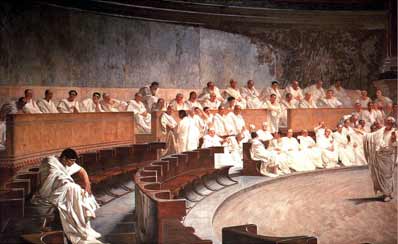
The ladder to political power in the Roman Senate was different for the wealthy patricians than for the lower-grade plebeians.
Information technology all began when the Romans overthrew their Etruscan conquerors in 509 B.C.Eastward. Centered north of Rome, the Etruscans had ruled over the Romans for hundreds of years.
Once free, the Romans established a republic, a government in which citizens elected representatives to rule on their behalf. A republic is quite dissimilar from a democracy, in which every citizen is expected to play an active role in governing the country.
Citizen
The Roman concept of the citizen evolved during the Roman Commonwealth and changed significantly during the afterward Roman Empire. After the Romans freed themselves from the Etruscans, they established a commonwealth, and all males over 15 who were descended from the original tribes of Rome became citizens. Citizens of Rome distinguished themselves from slaves and other noncitizens by wearing a toga; well-nigh wore a white toga. During the Empire, each emperor wore a purple toga to distinguish himself as the princeps, or "starting time citizen."
Citizenship varied profoundly. The total citizen could vote, ally freeborn persons, and practice commerce. Some citizens were not immune to vote or concord public part, merely maintained the other rights. A third type of citizen could vote and practive commerce, but could non hold part or marry freeborn women.
In the late Republic, male slaves who were granted their freedom could become total citizens. Around ninety B.C.E., non-Roman allies of the Democracy gained the rights of citizenship, and by 212 C.E, nether the Edict of Caracalla, all free people of the Roman Empire could become citizens.
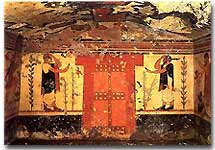
Frescoes line the walls of long-forgotten Etruscan tombs. This painting, found in the Tomb of Augurs in Tarquinia, is titled Hell's Door.
The elite (wealthy class) dominated the early Roman Republic. In Roman club, the aristocrats were known every bit patricians. The highest positions in the government were held by two consuls, or leaders, who ruled the Roman Republic. A senate equanimous of patricians elected these consuls. At this time, lower-grade citizens, or plebeians, had nigh no say in the government. Both men and women were citizens in the Roman Democracy, but simply men could vote.
Tradition dictated that patricians and plebeians should be strictly separated; matrimony between the ii classes was even prohibited. Over time, the plebeians elected their own representatives, chosen tribunes, who gained the power to veto measures passed past the senate.
Gradually, the plebeians obtained even more ability and somewhen could hold the position of consul. Despite these changes, though, the patricians were even so able to use their wealth to buy control and influence over elected leaders.
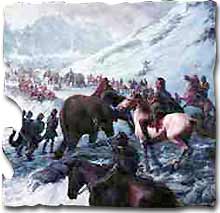
Hannibal marched his elephants s into the Italian peninsula during the Second Punic War.
The Roman Senate
The history of the Roman Senate goes as far back as the history of Rome itself. It was first created as a 100-fellow member advisory group for the Roman kings. Later kings expanded the group to 300 members. When the kings were expelled from Rome and the Republic was formed, the Senate became the most powerful governing body. Instead of advising the head of state, it elected the chief executives, chosen consuls.
Senators were, for centuries, strictly from the patrician class. They practiced the skills of rhetoric and oratory to persuade other members of the ruling body. The Senate convened and passed laws in the curia, a large building on the grounds of the Roman Forum. Much afterwards, Julius Caesar built a larger curia for an expanded Senate.
By the tertiary century B.C.East., Rome had conquered vast territories, and the powerful senators sent armies, negotiated terms of treaties, and had full control over the financial matters of the Republic.
Senatorial control was eventually challenged past Dictator Sulla around 82 B.C.Due east. Sulla had hundreds of senators murdered, increased the Senate'southward membership to 600, and installed many nonpatricians as senators. Julius Caesar raised the number to 900 (it was reduced after his assassination). Subsequently the creation of the Roman Empire in 27 B.C.E., the Senate became weakened under strong emperors who often forcefully coerced this ruling body. Although it survived until the fall of Rome, the Roman Senate had become simply a formalism body of wealthy, intelligent men with no power to dominion.
Occasionally, an emergency situation (such as a war) arose that required the decisive leadership of one individual. Under these circumstances, the Senate and the consuls could appoint a temporary dictator to dominion for a limited time until the crisis was resolved. The position of dictator was very undemocratic in nature. Indeed, a dictator had all the ability, made decisions without any approval, and had full control over the military.
The best instance of an ideal dictator was a Roman citizen named Cincinnatus. During a astringent armed services emergency, the Roman Senate called Cincinnatus from his subcontract to serve as dictator and to lead the Roman ground forces. When Cincinnatus stepped downwardly from the dictatorship and returned to his farm only 15 days after he successfully defeated Rome's enemies, the republican leaders resumed control over Rome.

The Twelve Tables
I of the innovations of the Roman Republic was the notion of equality under the law. In 449 B.C.East., government leaders carved some of Rome's most important laws into 12 corking tablets. The Twelve Tables, as they came to be known, were the offset Roman laws put in writing. Although the laws were rather harsh by today's standards, they did guarantee every citizen equal treatment under the law.
Laws from the Twelve Tables
With respect to the law and citizenship, the Romans took a unique approach to the lands that they conquered. Rather than rule those people as conquered subjects, the Romans invited them to become citizens. These people so became a function of Rome, rather than enemies fighting against information technology. Naturally, these new citizens received the same legal rights as everyone else.
The Punic Wars
The early Roman Republic often found itself in a country of constant warfare with its surrounding neighbors. In one instance, when the Romans were fighting the Carthaginians, Rome was most conquered. The people of Carthage (a city in what is today Tunisia in n Africa) were a successful trading civilization whose interests began to conflict with those of the Romans.
The two sides fought three bloody wars, known as the Punic Wars (264-146 B.C.E.), over the control of trade in the western Mediterranean Ocean. In the second state of war, Hannibal, a Carthaginian general, successfully invaded Italy by leading an army — consummate with elephants — across the Alps. He handed the Roman regular army a burdensome defeat but was unable to sack the urban center of Rome itself. After occupying and ravaging Italy for more than a decade, Hannibal was finally defeated past the Roman general Scipio at the Battle of Zama in 202 B.C.East.
Why "Punic"?
How did the give-and-take "Punic" become an adjective meaning "relating to the people of Carthage"?"Punic" is derived from the Latin word Poenicus, meaning "an inhabitant of Carthage." Carthage was founded by Phoenicians, and Poenicus is the Latin give-and-take for "Phoenician."
By the Third Punic War, Rome was ready to end the Carthaginian threat for practiced. After a successful several-twelvemonth siege of Carthage, the Romans burned the city to the basis. Legend has information technology that the Romans and so poured table salt into the soil so that nothing would ever grow there again. Carthage was finally defeated, and the Roman Commonwealth was rubber.
carpenterbeind1967.blogspot.com
Source: https://www.ushistory.org/civ/6a.asp
0 Response to "A Person Elected to Roman Counsul Served a Term of 1 Year and Could Not Run Again Until"
Postar um comentário